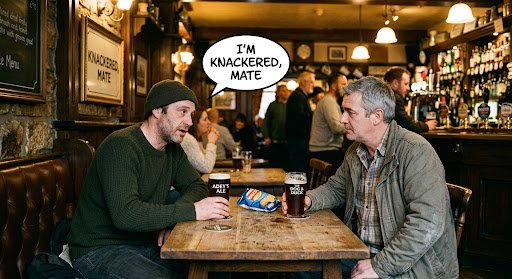
British slang is renowned for its humor, understated irony, subtext, and heavy use of wordplay. Influenced by regional dialects (from London Cockney to Northern English), social history, and modern multicultural youth culture (like London’s MLE or Multicultural London English), it forms a massive part of daily conversation across the UK.
While American slang tends toward directness and cultural references rooted in U.S. media and regional variations, British slang often relies more heavily on rhyming schemes, class distinctions, and dry wit.
Key Categories of British Slang
1. Daily Essentials & Casual Greetings
Mate: Friend or pal. Used universally for people you know, as well as total strangers in casual interactions (e.g., “Cheers, mate!”). In the U.S., “buddy” or “dude” serve similar functions, though “mate” carries less regional specificity in the UK.
Cheers: Used instead of “thank you,” “goodbye,” or as a traditional drink toast. Americans typically reserve “cheers” exclusively for toasting drinks, while Brits use it as an all-purpose expression of gratitude or farewell.
Innit: A contraction of “isn’t it?” Used at the end of a sentence to seek agreement or simply as a conversational filler (e.g., “It’s freezing outside, innit?”). The American equivalent might be “right?” or “you know?”
Alright?: A standard greeting that functions as both “hello” and “how are you?” The standard response is usually just saying “Alright?” back. Americans are more likely to use “What’s up?” or “How’s it going?” in similar contexts.
2. Expressions of Emotion & State of Being
Gutted: Devastated, profoundly disappointed, or upset.
- “I was absolutely gutted when they canceled the concert.”
- Americans might say “bummed out” or “crushed” instead.
Chuffed: Delighted, happy, or proud of an achievement. (Often paired as “chuffed to bits”).
- “He was dead chuffed with his new promotion.”
- The U.S. equivalent would be “stoked” or “pumped.”
Knackered: Extremely tired or physically exhausted.
- “I’ve been working a 12-hour shift—I’m knackered.”
- Americans would typically say “wiped out,” “beat,” or “exhausted.”
Gobsmacked: Astonished, speechless, or utterly amazed.
- “I was gobsmacked when I found out how much the ticket cost.”
- In American slang, “blown away” or “floored” convey similar shock.
3. Socializing, Money & Everyday Objects
Quid: A one-pound coin/note (£1). Always singular in slang (e.g., “That’s five quid, please”—never “quids”). Americans use “buck” or “bucks” for dollars, which does pluralize.
Skint: Broke; having no money.
- “I’d love to go to the pub, but I’m completely skint until payday.”
- Americans say “broke” or “tapped out.”
Loo: The bathroom or toilet. Americans use “bathroom,” “restroom,” or informally “john.”
Cuppa: A cup of tea. Short for “cup of tea.” Given tea’s cultural significance in the UK versus coffee in the U.S., this term has no direct American equivalent.
Brolly: An umbrella. Americans simply say “umbrella.”
4. Descriptions & Mild Insults
Dodgy: Suspicious, unreliable, or off-spec.
- “I wouldn’t buy a phone from that dodgy website.”
- Americans would say “sketchy” or “shady.”
Daft: Silly, foolish, or harmlessly ridiculous.
- “Don’t be daft, of course you’re invited.”
- The U.S. equivalent is “silly” or “goofy.”
Posh: High-class, elegant, or fancy. Americans use “fancy,” “upscale,” or “high-end.”
Bollocks: Literally means testicles, but commonly used to describe complete nonsense or a major mistake (e.g., “That’s a load of bollocks”). Note: Calling something “the dog’s bollocks,” however, confusingly means it is top-tier or excellent. Americans might say “bullshit” for nonsense, though the positive flip (“the dog’s bollocks”) has no direct U.S. parallel.
5. Modern & Regional Slang (MLE / Youth / Regional)
Peng: Very attractive, high-quality, or delicious (e.g., “That food was peng”). Emerging from MLE, this has similarities to American slang like “fire” or “lit.”
Banter (Bants): Playful teasing, witty remarks, or lighthearted joking between friends. While Americans understand “banter,” the term is far more culturally central in British conversation.
Proper: Used as an intensifier in place of “very” or “really” (e.g., “It’s proper cold today”). Americans use “really,” “super,” or “hella” (regional) in similar ways.
Cwtch (Welsh): A warm, comforting hug or cuddle. This Welsh term has no direct American equivalent but reflects the UK’s regional linguistic diversity.
Quick Comparison: UK vs. U.S. Equivalent Terms
| British Slang | American Equivalent |
|---|---|
| Chips | French fries |
| Crisps | Potato chips |
| Trainers | Sneakers |
| Boot (of a car) | Trunk |
| Faffing around | Messing around / wasting time |
| Rubbish | Trash / Garbage |
Key Differences in Slang Culture
While both British and American slang evolve rapidly and reflect their respective cultures, several patterns distinguish them:
- Class consciousness: British slang often carries markers of social class (e.g., “posh”), while American slang tends to be more regionally or ethnically coded.
- Understatement vs. hyperbole: British slang frequently employs ironic understatement, while American slang leans toward exaggeration and enthusiasm.
- Multicultural influence: Both countries’ slang reflects immigration and multiculturalism, but British slang (especially MLE) shows distinct influences from Caribbean, South Asian, and African communities, while American slang draws heavily from African American Vernacular English (AAVE) and Latino communities.
- Formality and politeness: British slang includes more terms for polite social rituals (“cheers,” “ta”), reflecting cultural norms around courtesy, whereas American slang often prioritizes casualness and directness.
Understanding these differences enriches cross-cultural communication and reveals how language reflects national character, history, and social values.