The English language crossed the Atlantic with British colonists in the 17th century, but over the following four hundred years, American English and British English diverged in pronunciation, spelling, vocabulary, and grammar. These differences arose from geographic separation, deliberate reform movements in the United States, and independent linguistic evolution on both sides of the ocean.
Where the Differences Came From
Geographic Separation and Evolving Pronunciation
When English settlers arrived in North America during the 1600s, they spoke a rhotic dialect—one that pronounced the “r” sound in words like hard, water, and car. During the 18th century, however, upper-class speakers in Southern England began dropping the “r” sound after vowels, a change that spread through much of England and became a marker of prestige speech. This non-rhotic pronunciation became characteristic of Received Pronunciation (RP), the accent associated with educated speakers in Southern England.
Meanwhile, American English largely preserved the older rhotic pronunciation. In this respect, modern American English retains features closer to the English spoken in Shakespeare’s time than many modern British accents do.
Noah Webster’s Spelling Reforms
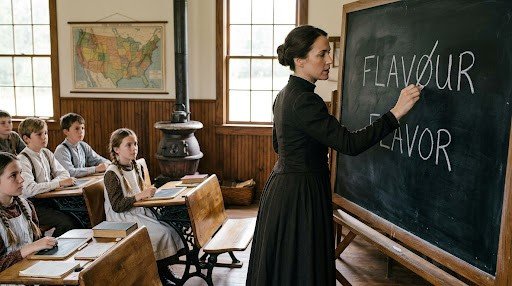
In 1828, lexicographer Noah Webster published An American Dictionary of the English Language. Webster sought to simplify English spelling and establish linguistic independence for the young United States. His reforms systematically altered spellings to reflect pronunciation more directly:
- He dropped the French-influenced -our ending in favor of -or (color, honor instead of colour, honour)
- He reversed -re to -er (center, theater instead of centre, theatre)
- He promoted -ize over -ise (organize, realize)
- He simplified doubled consonants and removed silent letters where possible
Many of Webster’s changes took hold in American usage and remain standard today.
Borrowed Vocabulary and Parallel Innovation
As American settlers moved westward, they encountered new landscapes, peoples, and technologies. They borrowed words from Indigenous languages (moose, raccoon, tomahawk), Spanish (ranch, canyon, rodeo), German (pretzel, delicatessen), and Dutch (cookie, boss).
At the same time, the Industrial Revolution produced new inventions on both sides of the Atlantic. Railroads, automobiles, and modern infrastructure developed in parallel, but each country coined its own terms for identical objects and concepts. The result is a rich vocabulary of everyday words that differ completely between American and British English.
Key Differences
Vocabulary
Many common objects and concepts have entirely different names in American and British English:
| Concept | American English | British English |
| Residence unit | Apartment | Flat |
| Vehicle front cover | Hood | Bonnet |
| Vehicle storage | Trunk | Boot |
| Pedestrian path | Sidewalk | Pavement |
| Baked sweet treat | Cookie | Biscuit |
| Thin fried potatoes | Chips | Crisps |
| Thick fried potatoes | French fries | Chips |
| Vertical transport | Elevator | Lift |
| Discarded items | Garbage / Trash | Rubbish |
| Fuel for vehicles | Gas / Gasoline | Petrol |
| Baby carriage | Stroller | Pram / Pushchair |
| Vacation | Vacation | Holiday |
These differences extend across thousands of everyday terms, though global media has increased mutual understanding.
Spelling Patterns
American and British spelling diverge in predictable patterns:
| Pattern | American | British | Examples |
| -or vs. -our | -or | -our | color/colour, favor/favour, honor/honour |
| -er vs. -re | -er | -re | center/centre, meter/metre, theater/theatre |
| -ize vs. -ise | -ize | -ise or -ize | realize/realise, organize/organise |
| -og vs. -ogue | -og | -ogue | catalog/catalogue, dialog/dialogue |
| Single vs. double l | Single l | Double l | traveling/travelling, canceled/cancelled |
| -ense vs. -ence | -ense | -ence | defense/defence, license/licence (noun) |
Note that -ize spellings remain widely accepted in British English, particularly in academic and scientific writing, and are preferred by major British publishers including Oxford University Press.
Grammar and Usage
Collective Nouns
American English treats collective nouns (team, government, committee) as singular:
- “The team is“
- “The government has announced new policies.”
British English often treats them as plural, emphasizing the individual members:
- “The team are“
- “The government have announced new policies.”
Past Tense and Past Participle Forms
American English strongly prefers regular -ed endings:
- learned, burned, smelled, spelled, spilled
British English frequently uses irregular -t forms:
- learnt, burnt, smelt, spelt, spilt
American English preserves the past participle gotten (distinct from got):
- “I’ve gotten better at chess.” (AmE)
- “I’ve got better at chess.” (BrE)
Prepositions and Verb Constructions
Small differences in preposition use distinguish the dialects:
- Time expressions: “on the weekend” (AmE) vs. “at the weekend” (BrE)
- Comparisons: “different than” or “different from” (AmE) vs. “different to” or “different from” (BrE)
- Communication: “write me” (AmE) vs. “write to me” (BrE)
- Possession: “Do you have…?” (AmE) vs. “Have you got…?” (BrE)
Pronunciation
Rhoticity
The most prominent pronunciation difference is rhoticity—whether speakers pronounce the “r” sound after vowels. American English is rhotic, pronouncing the “r” in car, park, hard, and water. Received Pronunciation and many other British accents are non-rhotic, dropping the “r” unless followed by a vowel sound.
However, pronunciation varies significantly by region in both countries. Some British accents (including those in Scotland, Ireland, and parts of Southwest England) are rhotic, while some American accents (notably in parts of New England and the American South) are non-rhotic.
Vowel Sounds
The “broad A”: Words like dance, fast, path, and half use a short /æ/ vowel (as in cat) in American English, but a broad /ɑː/ vowel (as in father) in Received Pronunciation and many other British accents.
The Letter T
In American English, a “t” sound between vowels often becomes a quick tap or flap, making water sound like “wah-der” and better like “beh-der.” British English typically maintains a crisp /t/ sound or, in some accents, uses a glottal stop (a catch in the throat).
Conclusion
American and British English remain mutually intelligible, but their differences reflect distinct historical paths. American English preserved certain older features while adopting Webster’s spelling reforms and vocabulary from diverse immigrant communities. British English evolved its own pronunciation changes and maintained different conventions. Both varieties continue to develop independently, shaped by their respective cultures, media, and global influences. Understanding these differences enriches our appreciation of English as a living, adaptable language that thrives in multiple forms.